
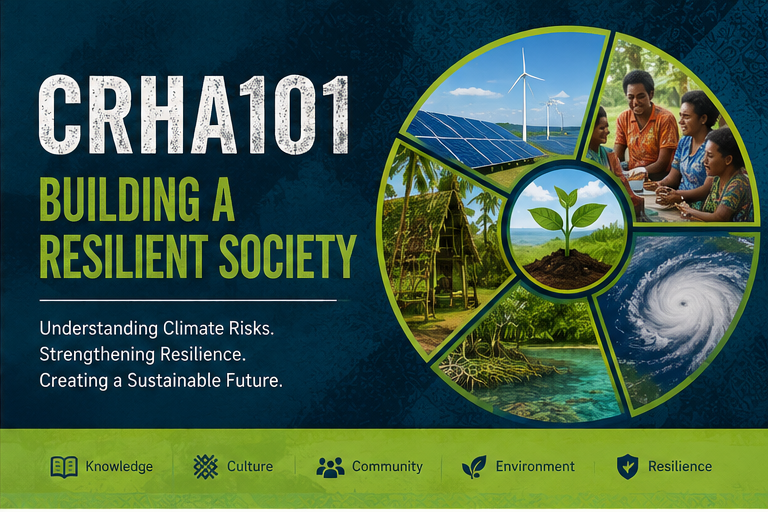
CRHA101 – Building a Resilient Society introduces students to the key concepts, challenges, and approaches involved in strengthening resilience in Vanuatu and the wider Pacific region. The course examines the realities of climate change and climate resilience, regional and local vulnerabilities, disaster risk, climate justice, Loss and Damage, and Vanuatu’s leadership in international climate advocacy. It explores the relationship between climate change and humanitarian action, socio-economic development, community wellbeing, social and cultural systems, and the natural environment. Particular attention is given to the importance of kastom, indigenous knowledge, social cohesion, gender and community participation in strengthening resilience. Students also examine Climate Resilient Development as an approach for integrating climate risks into development planning and protecting vulnerable communities. Through lectures, discussions, case studies, research activities, and examples from Vanuatu, the course encourages students to understand resilience as more than simply recovering from disasters; it involves building communities, institutions, ecosystems, livelihoods, and development systems that can anticipate risks, adapt to change, recover from shocks, and continue to improve people's wellbeing. Ultimately, CRHA101 encourages students to critically consider how Vanuatu can pursue a development pathway that is socially inclusive, culturally appropriate, environmentally sustainable, and resilient to present and future climate and disaster risks.
- Teacher: Matthew Kensen